
Why Founders Become the Bottleneck


Every founder begins as the center of the business.
They make the first sales, build relationships with customers, solve operational problems, hire employees, and make every important decision. During the early stages of growth, this hands-on approach is often one of the company's greatest strengths.
Eventually, however, the business changes.
The team grows. More clients come onboard. Projects become increasingly complex. Departments begin relying on one another instead of working independently.
Yet many founders continue operating exactly as they did when the company was much smaller.
This is where the founder bottleneck begins.
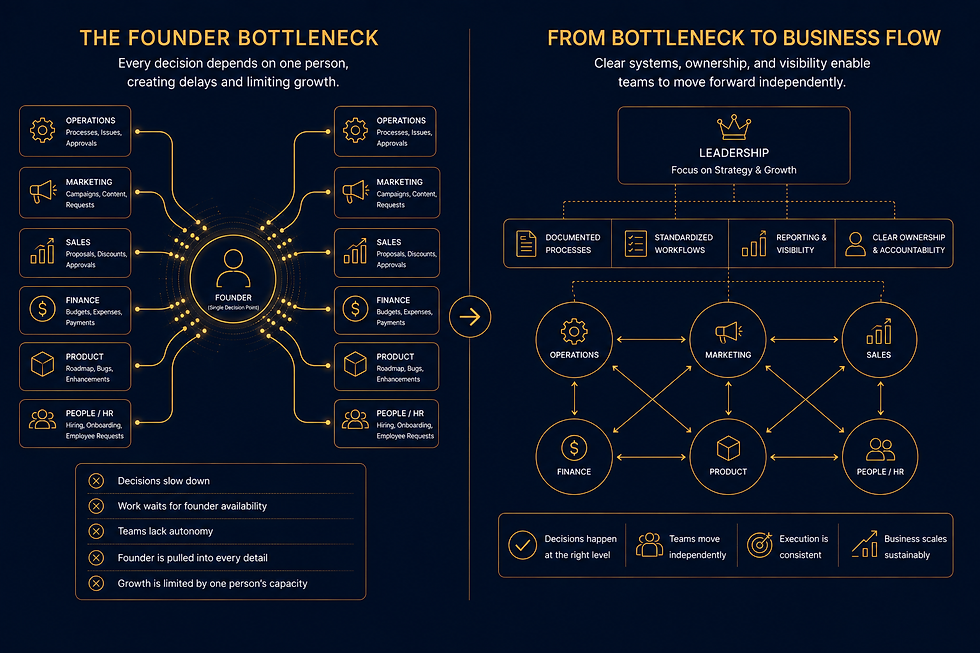
Growth doesn't slow because people stop working hard. It slows because too many decisions, approvals, and operational responsibilities continue flowing through one individual.
The business becomes limited by the capacity of its founder rather than the potential of its team.
Growth Creates More Decisions
Every successful business becomes more complex over time.
New employees require onboarding.
Customers expect faster responses.
Projects involve multiple departments.
Technology requires oversight.
Financial decisions become more significant.
None of these challenges are unusual.
The problem arises when every important decision still requires founder approval.
Instead of empowering teams to move work forward, projects pause while waiting for one person's availability.
As responsibilities increase, decision-making naturally slows, creating a classic founder bottleneck that affects the entire organization.

Delegation Isn't the Same as Empowerment
Many founders believe they're delegating because tasks are assigned to their team.
But delegation alone doesn't eliminate bottlenecks.
If every proposal still requires approval...
If every customer issue still comes back to leadership...
If every project depends on one person's decision...
The organization hasn't become more autonomous.
It has simply shifted administrative work while keeping decision-making centralized.
Operational maturity comes from establishing clear processes, defined ownership, and documented responsibilities that allow teams to make appropriate decisions independently.
This creates consistency while allowing founders to focus on strategic priorities instead of operational interruptions.
Systems Create Scalability
Businesses don't scale because founders work longer hours.
They scale because systems reduce dependency on individual people.
Standardized workflows create predictable execution.
Documented processes reduce uncertainty.
Reporting systems provide visibility without constant oversight.
Clearly defined ownership allows teams to move confidently.
When these systems exist, founders no longer need to answer every question or approve every small decision.
Instead, leadership can concentrate on long-term growth, customer relationships, innovation, and strategic planning.
Organizations with strong operational systems naturally reduce the risk of a founder bottleneck because decisions happen at the appropriate level throughout the business.
As explored in Business Documentation, organizations that document knowledge and standardize processes reduce dependency on individuals and make execution more consistent.
The Role of Leadership Changes
Founders don't stop being important as businesses grow.
Their responsibilities simply evolve.
Early-stage founders build the business.
Scaling founders build the organization.
That shift requires moving away from solving every operational problem personally toward building systems that enable others to solve problems consistently.
The strongest leaders aren't involved in every decision.
They create an environment where good decisions happen without them.
That's what allows businesses to continue growing without increasing complexity at the same pace.
Strong operational visibility also becomes essential. With effective Reporting Systems, leaders no longer need to interrupt teams for constant updates because they have the information needed to make informed decisions.
Building a Business That Doesn't Depend on One Person
Every growing business eventually reaches a point where founder involvement becomes the limiting factor.
Recognizing that moment is an opportunity, not a failure.
Businesses become more resilient when knowledge is documented, responsibilities are clearly defined, and operational systems support consistent execution.
Organizations that have established AI Readiness are also better positioned to automate repetitive work because their underlying processes are already standardized and well documented.
The goal isn't to remove founders from the business.
It's to remove unnecessary dependency on them.
When leadership focuses on strategy instead of constant operational intervention, teams become more empowered, execution becomes more consistent, and the business becomes significantly easier to scale.
Ready to reduce founder dependency and build systems that support sustainable growth? Schedule a Discovery Call to learn how Fractional Project Management helps organizations improve operational maturity, strengthen accountability, and create businesses that scale beyond a single decision-maker.


Comments