
Why AI Can't Fix Broken Processes


Artificial intelligence is changing how businesses operate. From drafting emails and summarizing meetings to automating repetitive tasks, AI is quickly becoming part of everyday work. For many organizations, the promise is simple: implement AI, save time, and improve productivity.
It's an exciting opportunity, but it's also one of the biggest misconceptions surrounding AI today.
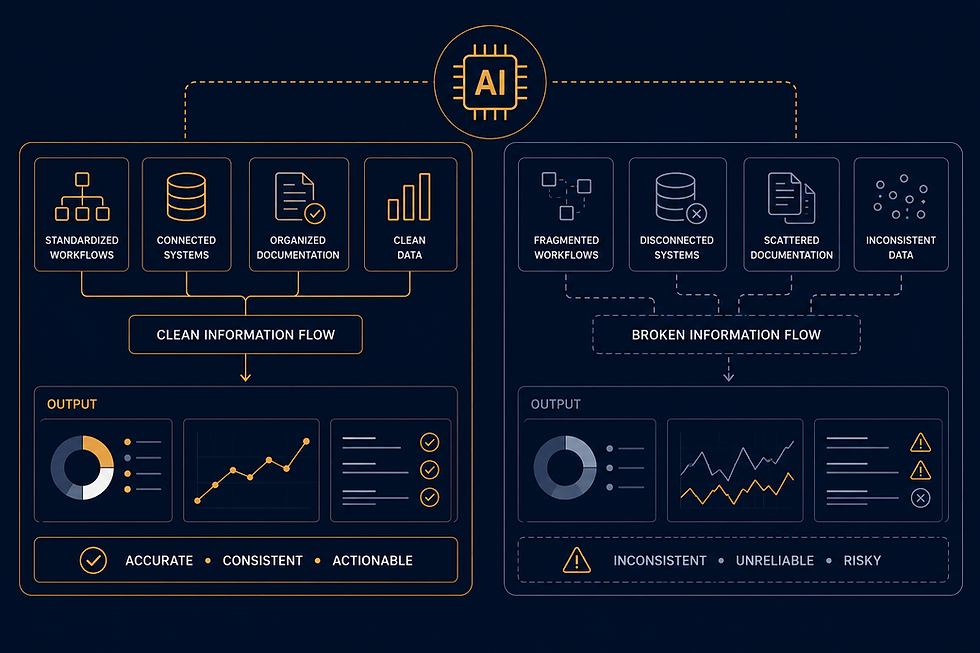
Technology alone doesn't solve operational challenges. If your workflows are inconsistent, your documentation is incomplete, or your teams rely on workarounds to get things done, AI won't fix those problems. Instead, it will make those same inefficiencies happen faster.
The businesses seeing the greatest success with AI didn't start with technology. They started by strengthening their business processes, creating a foundation that allows automation to deliver meaningful results.
AI Follows Your Existing Business Processes
Artificial intelligence doesn't redesign how your organization works. It follows the systems, instructions, and information you already provide.
Imagine two businesses implementing the same AI tool to automate customer onboarding.
The first business has documented procedures, standardized communication, and clearly defined responsibilities. Every client follows the same onboarding experience, making automation straightforward and predictable.
The second business operates differently. Team members handle onboarding in their own way, documentation is inconsistent, and approvals vary depending on who's available. Introducing AI into that environment doesn't create consistency. It simply automates inconsistency.
The same principle applies across project management, reporting, finance, HR, and operations. AI can process information quickly, but it can't determine which version of a process is correct if your organization hasn't already defined it.
Before investing in automation, leaders should first understand how work flows through their organization. Many operational issues begin with limited visibility into how teams actually execute their work. That's why improving Operational Visibility is often the first step toward building stronger operational systems.
Technology Amplifies Existing Operations
Every technology investment amplifies what's already happening inside the business.
Organizations with mature business processes often experience immediate benefits from AI because their operations are already structured. Teams know their responsibilities, workflows are documented, and information is consistent. AI simply removes repetitive administrative work, allowing employees to focus on higher-value activities.
Businesses with fragmented operations often experience something very different.
Instead of reducing complexity, AI generates more notifications, more reports, and more information without solving the underlying operational issues. Leaders still spend their days chasing updates because the process itself hasn't improved.
Technology doesn't create operational maturity.
It exposes it.
That's why successful AI adoption rarely starts with selecting software. It starts by evaluating whether your current business processes are ready to support automation in the first place.
Strong Business Processes Create Better Automation
Organizations often assume automation comes before process improvement.
In reality, it's the opposite.
The most successful automation initiatives begin with processes that are already working consistently.
Before introducing AI, ask questions like:
Are responsibilities clearly defined?
Are recurring workflows documented?
Does everyone follow the same process?
Can leadership understand project status without requesting updates?
Is reporting based on accurate and reliable information?
When the answer is yes, automation becomes significantly easier because there is consistency to build upon.
This is also why leaders should focus on measuring outcomes instead of simply tracking activity. Understanding the difference between Activity and Progress helps organizations identify where automation creates real value instead of simply accelerating busy work.
Strong business processes don't limit innovation. They create the stability that allows innovation to succeed.
Where AI Creates the Greatest Value
When supported by mature operational systems, AI becomes a powerful assistant rather than a replacement for good management.
Organizations are already using AI to:
Summarize meeting discussions and action items.
Draft project documentation.
Generate executive reports.
Organize internal knowledge bases.
Analyze operational trends.
Prioritize incoming requests.
Assist with routine communication.
Notice what these examples have in common.
None of them replace leadership.
None of them replace operational decision-making.
Instead, they reduce repetitive administrative work so people can spend more time solving problems, collaborating, and improving execution.
That's where AI delivers its greatest value.

Preparing Your Business for AI
Businesses don't become AI-ready by purchasing software.
They become AI-ready by creating consistent business processes that technology can support.
That means documenting workflows, clarifying ownership, improving reporting, and creating operational visibility before introducing automation.
Many leaders hope AI will eliminate meetings, reduce manual updates, or improve productivity overnight. In reality, those challenges are often symptoms of operational inefficiencies rather than technology limitations. Building effective Reporting Systems gives leadership the visibility they need while allowing teams to work with greater autonomy and confidence.
AI has tremendous potential to improve how organizations operate.
But productivity starts with process.
Organizations that invest in stronger business processes today will be far better positioned to adopt emerging technologies tomorrow, regardless of how quickly AI continues to evolve.
Ready to strengthen your business processes before investing in AI? Schedule a Discovery Call to explore how Fractional Project Management can help your organization build scalable operations, improve execution, and create a stronger foundation for future growth.


Comments