
How to Scale Delivery Without Hiring a Large Team


As organizations grow, delivery complexity grows with them.
More projects. More stakeholders. More dependencies. More pressure to move faster.
At some point, many leaders begin asking the same question:
“Do we need to hire more people?”
Sometimes the answer is yes.
But in growing organizations, scaling execution is not always a hiring problem.
In many cases, the ability to scale project delivery depends less on team size and more on operational clarity, accountability, prioritization, and delivery systems.
Adding headcount to inconsistent execution rarely creates predictability.
Stronger systems often do.
Why More People Do Not Always Solve Delivery Problems
When execution slows down, hiring often feels like the fastest solution.
But larger teams can also create:
More communication complexity
More dependencies
More coordination overhead
More decision bottlenecks
More reporting friction
Without clear delivery systems, scaling a team can unintentionally scale inefficiency.
Many organizations discover that execution problems stem from unclear ownership, shifting priorities, weak accountability, or inconsistent workflows—not simply lack of capacity.
This is often why projects struggle as organizations grow.
Related reading: Why Projects Fail in Growing Companies
What Helps Organizations Scale Project Delivery
Organizations that successfully scale project delivery usually focus on execution systems before increasing headcount.
Here are several ways growing businesses improve delivery capacity without immediately hiring a large team.
1. Improve Prioritization
One of the biggest barriers to delivery scale is competing priorities.
When everything feels urgent, teams become reactive.
Projects stall because focus disappears.
Scaling execution often starts with helping teams answer:
What matters most right now?
Which initiatives move business goals forward?
What should wait?
Stronger prioritization reduces operational noise and allows existing teams to focus on meaningful execution.
2. Create Better Accountability Systems
Execution slows when ownership is unclear.
Many growing organizations rely too heavily on follow-ups, meetings, or leadership intervention to keep work moving.
Scalable delivery environments rely on clear accountability:
Defined ownership
Clear decision-making paths
Transparent reporting expectations
Escalation processes for blockers
When accountability improves, teams spend less time chasing updates and more time executing.
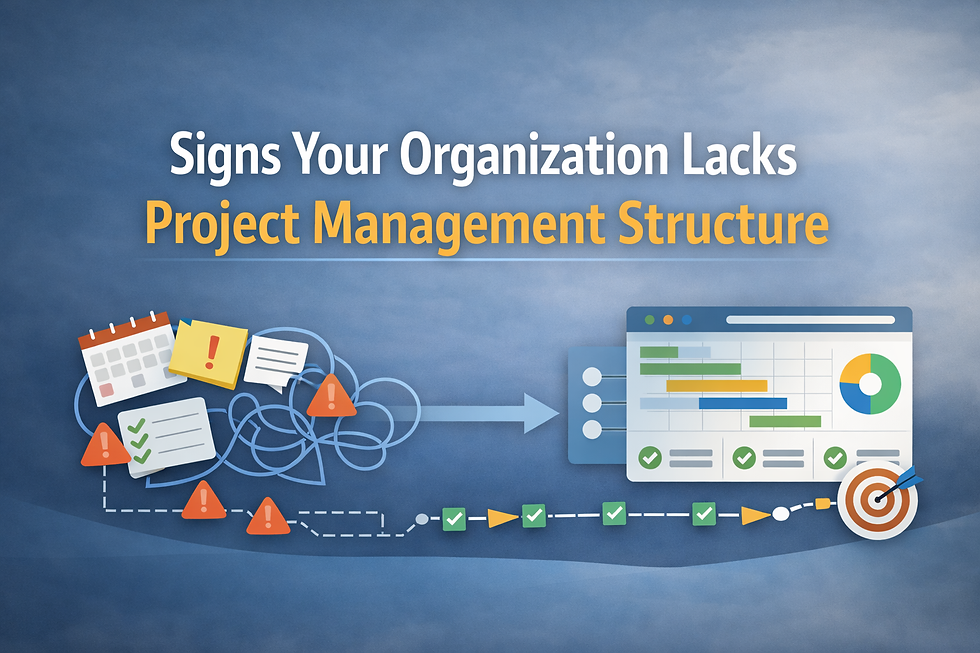
Organizations struggling here may benefit from evaluating some of the operational warning signs discussed in Signs Your Organization Lacks Project Management Structure.

3. Improve Cross-Functional Coordination
Growth increases coordination complexity.
As teams expand, delivery becomes increasingly dependent on multiple departments working together.
Misaligned timelines, unclear handoffs, and inconsistent communication create friction that slows execution.
Organizations can improve delivery capacity without hiring by strengthening:
Cross-functional communication rhythms
Dependency management
Shared delivery visibility
Consistent reporting systems
Small operational improvements often unlock major execution gains.
For a deeper look at alignment challenges, see How to Improve Cross-Functional Team Alignment.
4. Improve Delivery Visibility
Scaling becomes difficult when leaders lack visibility into execution.
Without visibility:
Risks surface too late
Priorities drift
Teams duplicate effort
Decision-making slows
Better delivery visibility creates faster, more confident execution.
That does not necessarily mean more meetings.
Often, it means clearer workflows, reporting structures, and operating rhythms.
5. Standardize Repeatable Workflows
Organizations struggle to scale when every project operates differently.
As complexity grows, repeatability matters.
Creating lightweight, repeatable delivery processes can improve consistency without creating bureaucracy.
Examples include:
Standard project workflows
Consistent reporting cadences
Shared prioritization frameworks
Clear project intake processes
Defined ownership structures
This is where scalable project management becomes important.
The goal is not more process for the sake of process.
It is creating systems that support faster execution.
A Better Question Than “Do We Need More People?”
Instead of asking:
“Should we hire a bigger team?”
Organizations should ask:
“What is limiting delivery?”
Sometimes the issue is capacity.
But often, delivery slows because execution systems have not matured alongside growth.
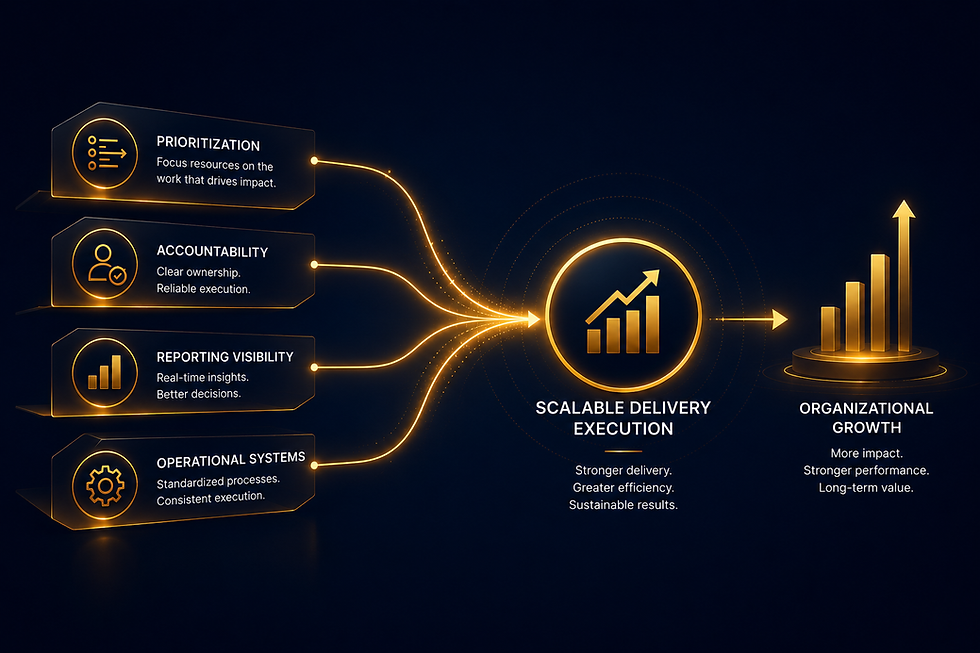
When priorities, accountability, visibility, and coordination improve, organizations frequently discover they can do more with the teams they already have.
Final Thoughts
Scaling execution does not always require scaling headcount.
In many growing organizations, stronger systems create more leverage than larger teams.
The ability to scale project delivery often depends on operational clarity, accountability, and consistent execution systems, not simply adding more people.
Before expanding your team, it may be worth evaluating whether delivery challenges stem from limited capacity or limited structure.
The strongest organizations scale both thoughtfully.
At Fractional Project Management, we help growing organizations improve delivery systems, strengthen execution visibility, and scale project delivery without unnecessary operational complexity. If delivery feels harder as your business grows, schedule a call to discuss how to create more scalable execution systems before adding unnecessary headcount.


Comments